
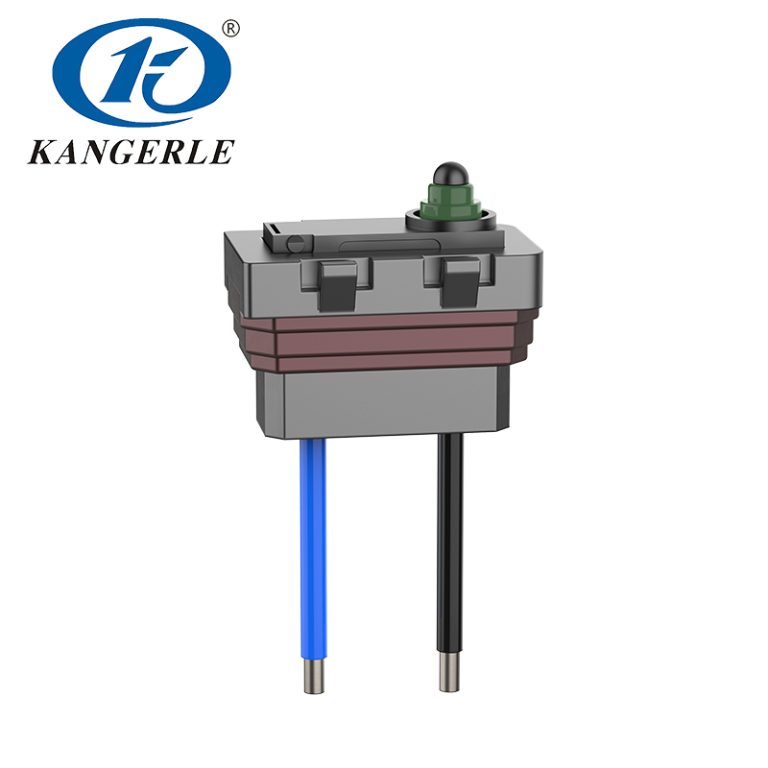
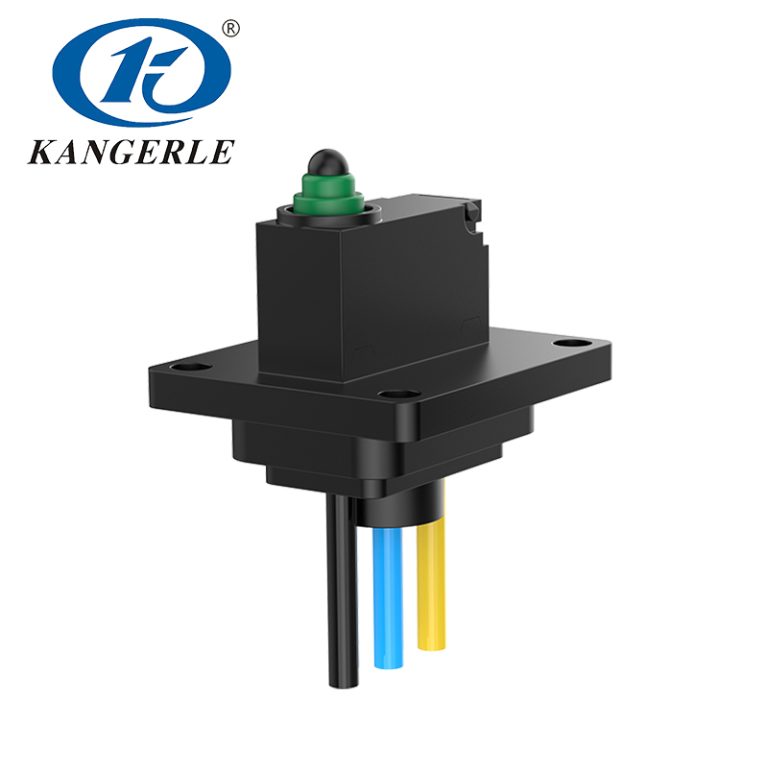
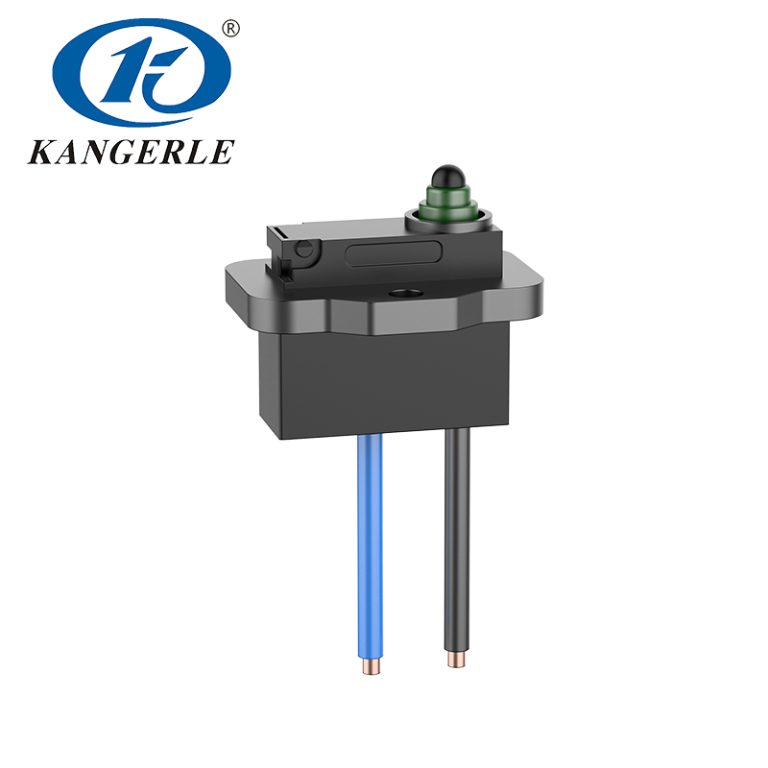

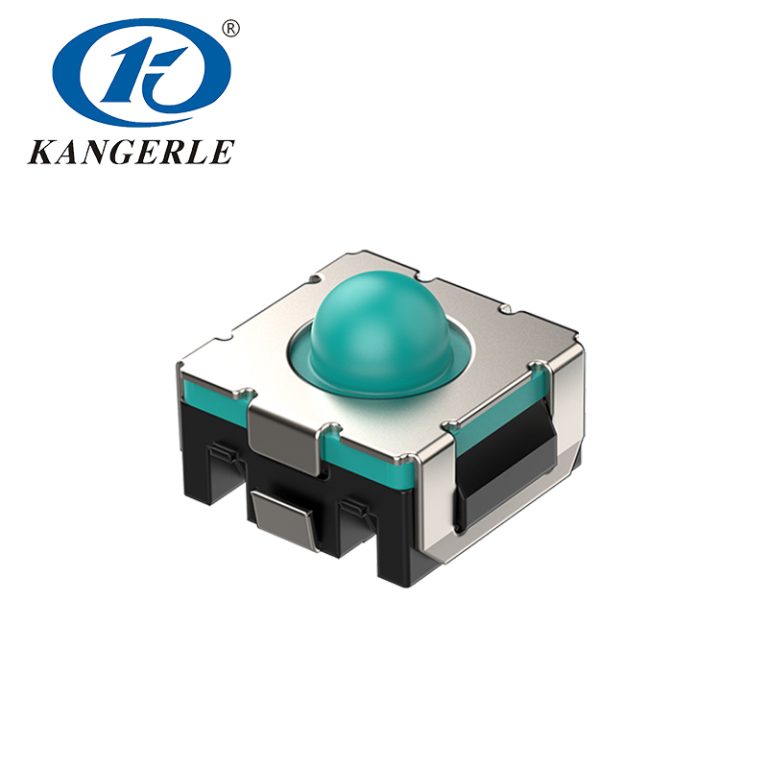
Microswitches may seem small, but in many cases they do crucial work – from verifying the cover of an appliance is closed, to checking the locking state of a plug connector on a new energy vehicle charger, or controlling the internal circuit of a power tool. The choice should take into account the electrical load, contact type, actuator type, mounting type, ingress protection, and life time.
Five models described in this paper are snap action, PCB mounted, and IP67 micro switches. They can be used in the automotive industry, home appliances, machinery, and others, making it easier for engineers and buyers to make an initial choice of a component.
What Are the Main Factors When Selecting a Micro Switch?
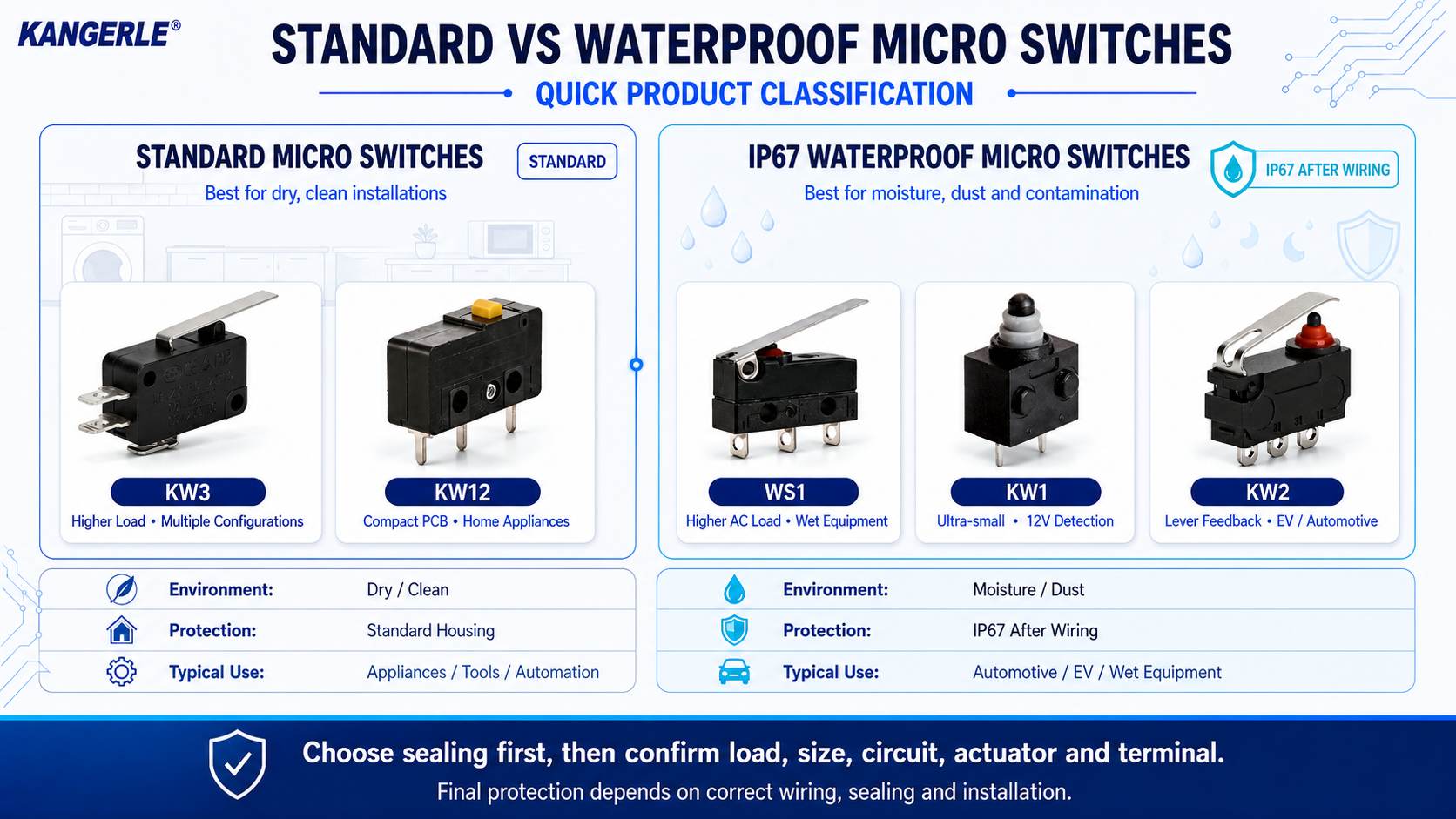
Micro switch selection should begin with the actual application rather than product dimensions alone. An appliance used in a dry environment and an automotive door lock exposed over time to moisture, dust, and vibration place entirely different demands on a switch.
Electrical Load, Contact Configuration, Actuator Design, and Operating Environment
First confirm the actual AC or DC load, then select the contact configuration. SPST (single-pole, single-throw) is suitable for simple on/off control; SPDT (single-pole, double-throw) allows the common terminal to switch between two contacts. Mechanical fit is equally important: pin plungers, straight levers, roller levers, and curved levers have different requirements for operating travel, mounting position, and force direction.
The mounting method also affects product selection. PCB terminals are suitable for direct installation on a control board, while solder and quick-connect terminals are better suited to wire-harness connections. If the switch will be exposed to moisture, dust, washing, or outdoor conditions, an IP67 waterproof micro switch is generally more suitable than a standard micro switch.
How Should the Rated Current Be Evaluated?
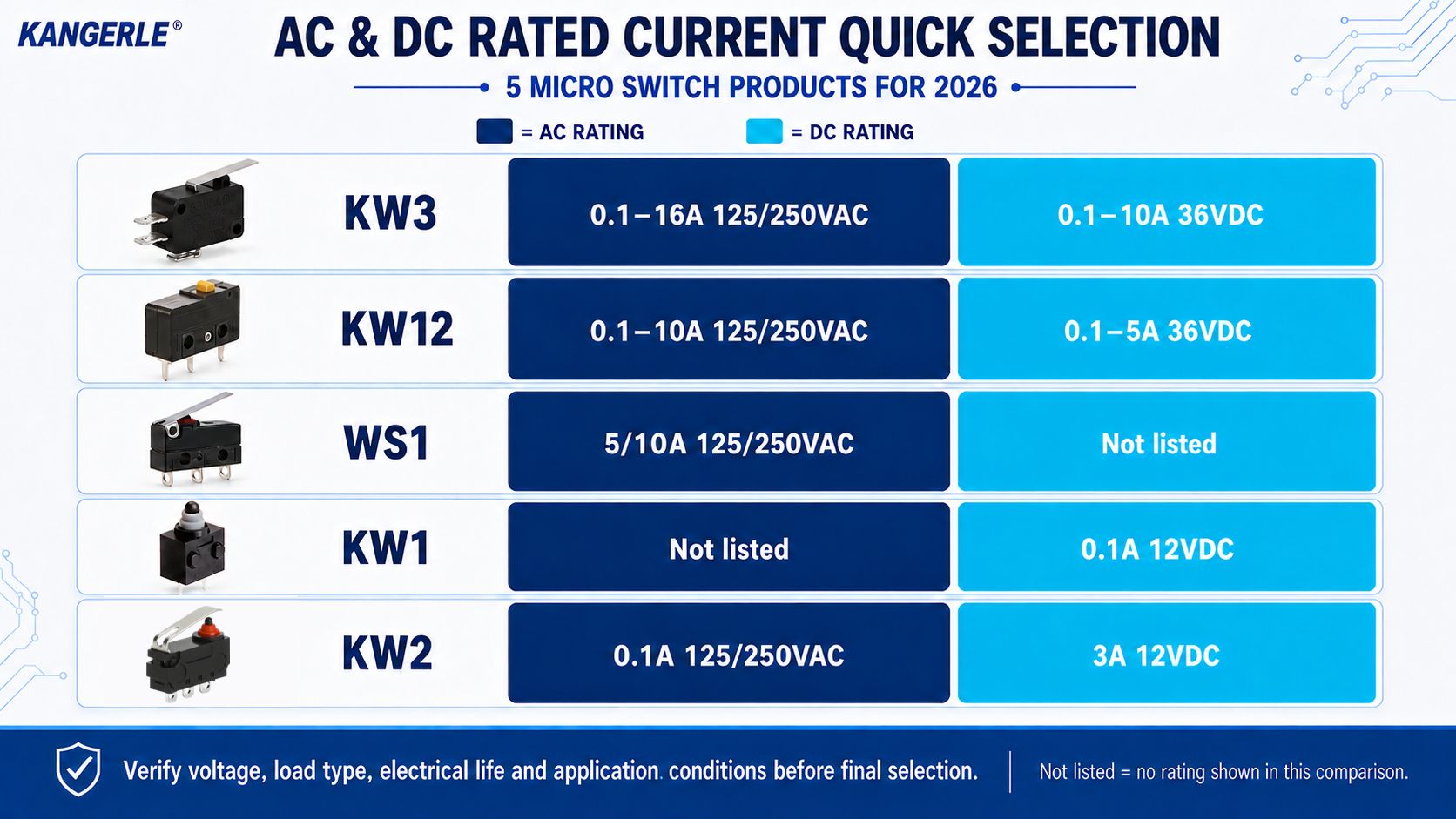
Rated current is a key parameter in micro switch selection, but the series maximum should not be considered in isolation. The KW3 series has a rated current range of 0.1-16 A at 125/250 VAC and 0.1-10 A at 36 VDC; the KW12 series has a rated current range of 0.1-10 A at 125/250 VAC and 0.1-5 A at 36 VDC.
- First determine whether the load uses AC or DC. AC and DC ratings are not directly interchangeable; select the product according to the applicable VAC or VDC specification.
- Inductive loads such as motors, pumps, solenoid valves, and relays may generate substantial inrush current when starting or switching off, so an appropriate margin should be allowed.
- A series current range does not mean that every complete model carries every rating. Specifications may differ according to the terminal, contact material, certification, and load type.
- Before full-scale production, sample testing under the actual voltage, load, operating frequency, and environmental conditions is recommended.
Selection tip: If a customer provides only an amperage value, the operating voltage, AC or DC supply, load type, and operating frequency must also be confirmed before determining whether the switch is suitable.
How Should Terminals, Levers, and Operating Force Be Selected?
Once the current requirement is met, the terminal type, lever design, operating force, and operating travel must also be checked. These parameters directly affect whether the switch can be installed correctly and whether the mechanism can actuate it reliably.
- The KW3 series supports solder, quick-connect, and PCB terminals as well as multiple lever options. Common operating forces listed in the selection guide include 30 gf, 60 gf, 100 gf, 150 gf, 200 gf, and 350 gf.
- The KW12 series is suitable for compact PCB assemblies and is available with different terminals and levers. Operating force can be kept within 200 gf, depending on the complete model number.
- A pin plunger is suitable for direct actuation; straight and long levers can shift the point of force application and reduce the actuation force required from the mechanism.
- A roller lever is suitable for cams, slide rails, or continuously moving mechanisms and can reduce sliding friction, but the actuation direction and overtravel must still be confirmed.
- PCB terminals are suitable for direct mounting on a control board; solder and quick-connect terminals are better suited to wire-harness connections or later maintenance.
If space, the actuation point, or the force direction is unusual, provide an installation drawing or an overall assembly drawing before confirming the terminal orientation, lever length, and operating force.
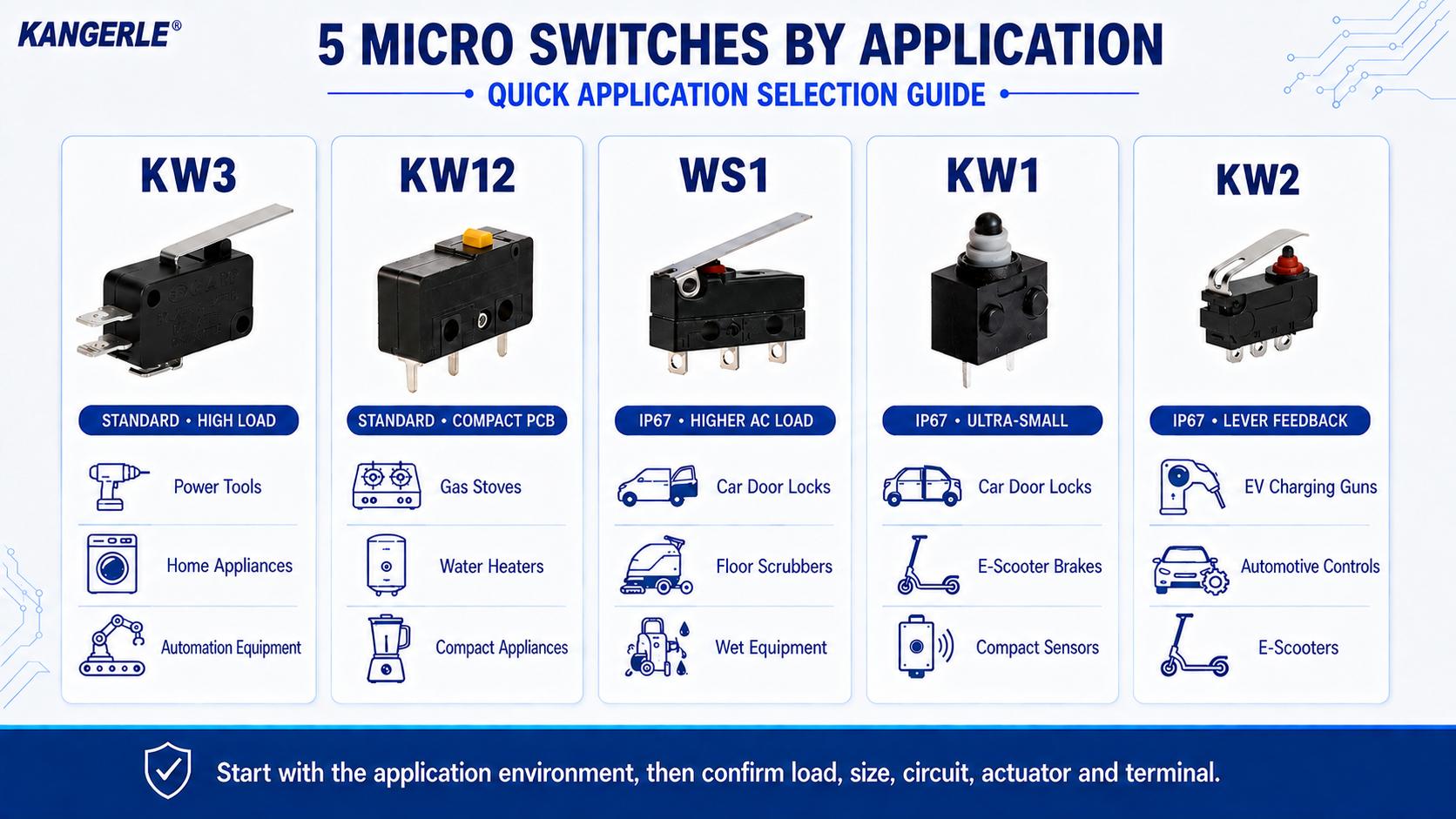
5 Micro Switch Products Worth Watching in 2026
These five micro switches suit different electrical loads and mechanical designs. They should be compared according to the actual application rather than treated as directly interchangeable products.
1. KW3-6A-C: A Versatile Snap-Action Micro Switch
The KW3-6A-C is a widely applicable snap-action micro switch. The KW3 series is available in SPDT, SPST-NO, and SPST-NC contact configurations, with multiple operating force, terminal, and lever options. According to the selection guide, the KW3 series has a rated current range of 0.1-16 A at 125/250 VAC and 0.1-10 A at 36 VDC, with a mechanical life of more than 1 million operations.
Typical applications include power tools, household appliances, automation equipment, communications equipment, instruments and meters, and automotive electronics. The KW3 series’ main advantage is its configuration flexibility: different levers and terminals can be combined within the same series to accommodate a variety of mechanical designs.
2. KW12-5A-C: Compact PCB-Mounted Micro Switch
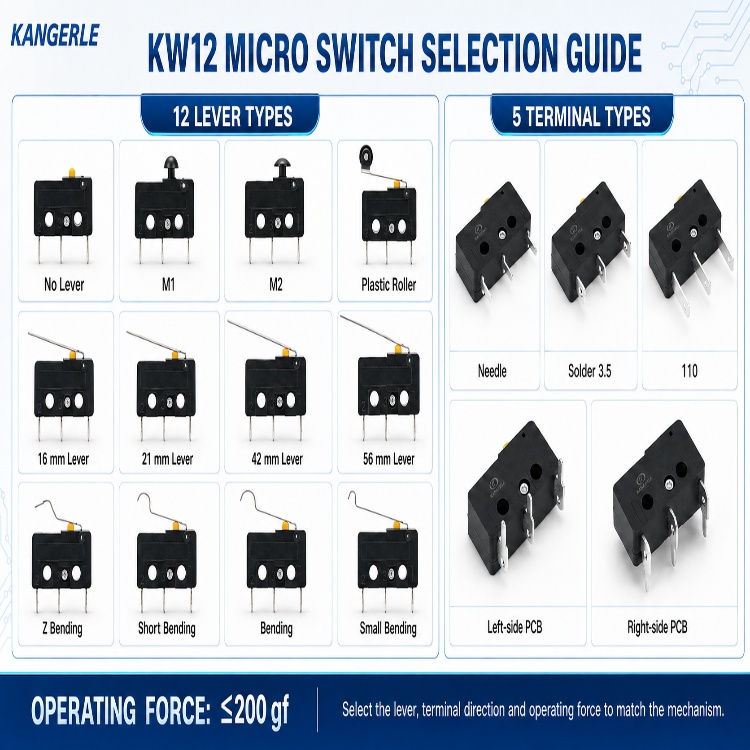
The KW12-5A-C is a compact, three-terminal PCB micro switch that can be mounted directly on a circuit board. According to the selection guide, the KW12 series has a rated current range of 0.1-10 A at 125/250 VAC and 0.1-5 A at 36 VDC. It is available in SPDT, SPST-NO, and SPST-NC contact configurations, with different terminal and lever options.
Its operating temperature range is -25°C to +125°C, making it suitable for appliances such as electric kettles, gas stoves, water heaters, ice makers, meat grinders, inflator pumps, and juicers.
On control boards with limited space, the KW12 can reduce wire-harness connections and save installation space. Before finalizing the PCB layout, however, the actuation point, operating travel, and mounting dimensions must still be checked carefully.
3. WS1-10A-1A: An IP67 Waterproof Micro Switch for Higher AC Loads
The WS1-10A-1A uses a compact sealed construction and has a 19 mm straight metal lever. The WS1 series is rated at 5/10 A, 125/250 VAC and is available in SPDT, SPST-NO, and SPST-NC contact configurations. After wiring is completed, it can achieve an IP67 rating, with a mechanical life of more than 1 million operations.
This waterproof micro switch is suitable for equipment exposed to moisture or dust, or involving continuous movement. Applications include new energy vehicle charging connectors, automotive door locks, seat-belt buckles, power liftgates, electric scooter brake locks, car-wash equipment, lawn mowers, coffee machines, and ice makers.
When a project requires both IP67 protection and higher AC load capacity, the WS1 can be given priority consideration.
4. KW1-1C-2C: Subminiature 12 V Waterproof PCB Micro Switch
The KW1-1C-2C is a sealed, two-terminal subminiature micro switch for low-voltage control circuits. It can be mounted directly on a PCB, can achieve an IP67 rating after wiring, and is available in SPST-NO or SPST-NC contact configurations. The rated load is 0.1 A at 12 VDC, and the mechanical life is at least 300,000 operations.
Its compact construction is suitable for space-constrained equipment such as automotive door locks, smart parcel lockers, electric bicycle and electric scooter brakes, robot vacuum cleaners, electric toothbrushes, and vehicle discharge outlets.
The KW1 is not intended to replace higher-current micro switches such as the WS1. Its advantage is waterproof position detection in a compact 12 V design.
5. KW2-1A-1B-B: Waterproof Lever Micro Switch for New Energy Vehicle Systems
The KW2-1A-1B-B is a compact IP67 waterproof micro switch with a 13.65 mm lever. The KW2 series supports SPDT, SPST-NO, and SPST-NC contact configurations, with ratings including 0.1 A at 125/250 VAC and 3 A at 12 VDC. Electrical life exceeds 100,000 operations, and mechanical life is at least 500,000 operations.
One of the KW2’s key applications is lock-status feedback in new energy vehicle charging connectors. It can also be used in automotive door locks, power liftgates, ignition controllers, gear selectors, central locking systems, and vehicle lighting controls.
If a project requires a small size, lever actuation, a 12 V operating voltage, and sealed position feedback, the KW2 is worth considering.
Quick Specification Comparison of 5 Micro Switches
The specification comparison below can help narrow the initial selection before product drawings are reviewed or samples are requested for testing.
| Modello | Product Type | Main Ratings | Tipo di contatto | Ingress Protection | Typical Applications |
| KW3-6A-C | General-Purpose Snap-Action | 0.1-16 A 125/250 VAC; 0.1-10 A 36 VDC | SPDT / SPST | Standard | Power tools, appliances, and automation equipment |
| KW12-5A-C | Compact PCB-Mounted | 0.1-10 A 125/250 VAC; 0.1-5 A 36 VDC | SPDT / SPST | Standard | Compact appliance control boards |
| WS1-10A-1A | Waterproof Lever Type | 5/10 A 125/250 VAC | SPDT / SPST | IP67 | Equipment in humid conditions or with higher loads |
| KW1-1C-2C | Subminiature Waterproof PCB Type | 0.1 A 12 VDC | SPST | IP67 | Low-voltage, compact equipment |
| KW2-1A-1B-B | Waterproof Lever Type | 3 A 12 VDC | SPDT / SPST | IP67 | New energy vehicles and automotive controls |
Note: The information above is compiled from publicly available specifications for these five models and their respective series. Refer to the final approved specification sheet for exact parameters.
How Can You Select Quickly for Different Applications?
Various models can be used for the same application purpose. This comparison table is to help narrow down your options, but ultimately your decision should be based on the power requirements, mounting space, and type of actuator.
| Applicazione | Suggested Series | Main Reason for Selection |
| Air fryers, washing machines, and kitchen appliances | KW3 | Wide current range with numerous terminal, lever, and operating-force options |
| Electric kettles, gas stoves, and compact control boards | KW12 | Compact size, suitable for PCB mounting and space-constrained appliances |
| Automotive door locks, liftgates, and equipment in humid environments | WS1 | Can achieve IP67 after the specified wiring is completed and can carry higher AC loads |
| Automotive door locks and electric bicycle brake buttons | KW1 | Subminiature construction for waterproof position detection in low-voltage 12 V systems |
| New energy vehicle charging connectors and automotive mechanism feedback | KW2 | Compact waterproof lever design for sealed 12 V feedback circuits |
Application note: With regard to automotive door locks, charging connectors, electric bicycle brake buttons, and other similar applications, the waterproof grade, vibration, temperature, wiring harness exit orientation, and physical travel must be considered.
How Can You Quickly Choose Among the 5 Micro Switches?
Start by assessing the operating environment and electrical load, then check the product dimensions, actuator design, and contact logic.
- Choose KW3: For projects requiring a wide current range and multiple lever or terminal configurations.
- Choose KW12: For space-constrained appliance control boards requiring direct PCB mounting.
- Choose WS1: For equipment requiring both IP67 protection and higher AC load capacity.
- Choose KW1: For very compact 12 V waterproof position-detection circuits.
- Choose KW2: For sealed lever-actuated feedback in new energy vehicle charging connectors or automotive mechanisms.
Sample testing is still recommended before volume production. Operating travel, overtravel, operating force, component tolerances, wire exit direction, and the way the mechanism presses the switch can all affect performance in the actual application. Micro switch selection should therefore evaluate the electrical load, dimensions, environment, actuation method, and reliability together rather than focusing on a single parameter.
What Information Is Needed Before Requesting a Quote or Sample?
The more complete the information, the easier it is for the manufacturer to recommend a suitable model quickly and the less time will be spent revising samples. Confirm the following when requesting a quote or sample:
- Electrical parameters: Operating voltage, operating current, and AC or DC supply.
- Load type: Resistive load, inductive load, lamp load, or signal detection.
- Contact logic: SPDT, SPST-NO, or SPST-NC, plus the actual wiring method.
- Mounting conditions: Overall dimensions, mounting holes, PCB layout, terminal orientation, and available space.
- Actuation parameters: Plunger or lever design, operating force, operating travel, overtravel, and actuation direction.
- Operating environment: Temperature, moisture, dust, vibration, washing conditions, and whether IP67 is required.
- Reliability requirements: Mechanical life, electrical life, operating frequency, and required certifications.
- Order information: Sample quantity, estimated annual volume, lead time, and whether customization is required.
Can Micro Switch Leads and Wire Harnesses Be Customized?
Yes. Kangerle can customize switch leads and wire harnesses to project requirements, including wire specifications, wire numbers or colors, wire length, strip length, end connectors, and wire exit direction. For waterproof micro switches, the sealing treatment after soldering and the installation method in the complete assembly must also be confirmed.
Customers are advised to provide a wire-harness drawing, connector model, or physical sample, and to approve the first article and sample test results before volume production.
Zhejiang Kangerle Electronics: Micro Switch Manufacturer
Zhejiang Kangerle Electronics Co., Ltd. has specialized in switch products for more than 20 years, and its Wenzhou plant has been in operation for over two decades starting from early 1990s. Its product line includes micro switches, waterproof micro switches, detecting switches, limit switches, rocker switches, slide switches, tactile switches, push-button switches and others.
It has gained ISO 9001:2015 & IATF 16949 quality system certificates, and its related products have UL, TUV, CE, CB, CQC, ROHS certifications and others.
The company has established ISO 9001:2015 and IATF 16949 quality management systems, and relevant products are available with certifications including UL, TUV, CE, CB, CQC, and RoHS. OEM/ODM services cover materials, dimensions, operating force, travel, current requirements, special environments, tooling development, sample production, and volume production.
If an existing switch largely meets the requirements but its lever, terminal, wire, operating force, or housing still needs adjustment, customization is often more efficient than redesigning the entire mechanism. Kangerle can support switch selection and customization for automotive, household appliance, consumer electronics, and other applications.
Conclusione
No single micro switch suits every application. The KW3 offers configuration flexibility; the KW12 suits compact PCB assemblies; the WS1 combines IP67 protection with higher AC load capacity; the KW1 suits subminiature 12 V systems; and the KW2 is better suited to feedback circuits in automobiles and new energy vehicles.
Correct selection depends on matching the electrical load, contact configuration, actuation method, mounting structure, operating environment, and service-life requirements to the actual mechanism. If a project has special requirements for dimensions, wires, operating force, or the environment, a custom micro switch may be more appropriate than modifying the complete assembly.
Domande frequenti
What Is the Difference Between a Micro Switch and a Tactile Switch?
Micro switches generally use a snap-action mechanism and are commonly used for position detection, safety interlocks, limit detection, or load switching. A tactile switch is usually a momentary push switch that primarily provides the user with distinct tactile feedback. The two differ in mechanical construction, mode of operation, and typical applications.
What Does IP67 Mean for a Waterproof Micro Switch?
IP67 indicates that the product is dust-tight and can withstand brief immersion in water under specified test conditions. For the KW1, KW2, and WS1, the protection rating should be confirmed in the wiring or soldered-lead condition specified in the selection guide. IP67 does not mean that the complete assembly automatically achieves the same level of protection after installation; wires, seals, housing design, and mounting method still affect the final result.
Is SPDT Always Better Than SPST?
Not necessarily. SPST is suitable for simple on/off circuits; SPDT has a changeover contact that allows the common terminal to switch between two circuits. The selection should be based on the control logic and wiring method. Neither configuration is better in every application.
Can an AC Rating Be Applied Directly to a DC Load?
Direct conversion is not recommended. A DC arc is generally more difficult to extinguish, so the allowable current for the same switch under DC conditions is often lower than under AC conditions. Select according to the VDC rating in the specification sheet and test with the actual load.
Does a Series Current Range Apply to Every Model?
No. A series range indicates that the series can cover these loads through different contact materials, terminals, or constructions, but a particular complete model may correspond to only part of that range. Confirm the complete model number, rating, and required certifications before ordering.
Can Kangerle Customize Soldered Leads and Connectors?
Yes. Wire specifications, length, color or wire number, end connectors, and wire exit direction can be customized to drawings, with samples provided for approval. Waterproof applications also require verification of the soldered-lead seal and the protection achieved after final assembly.