
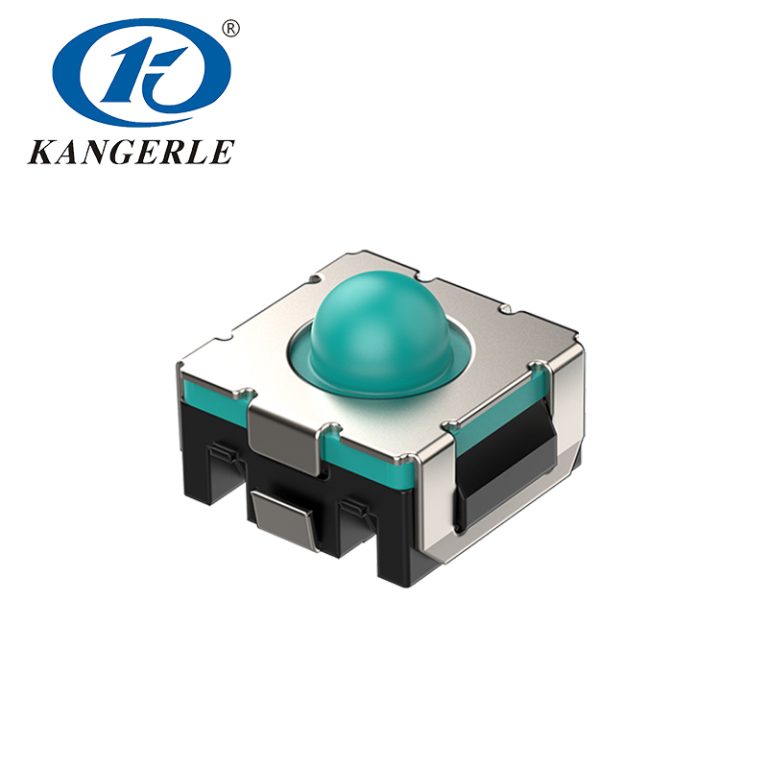
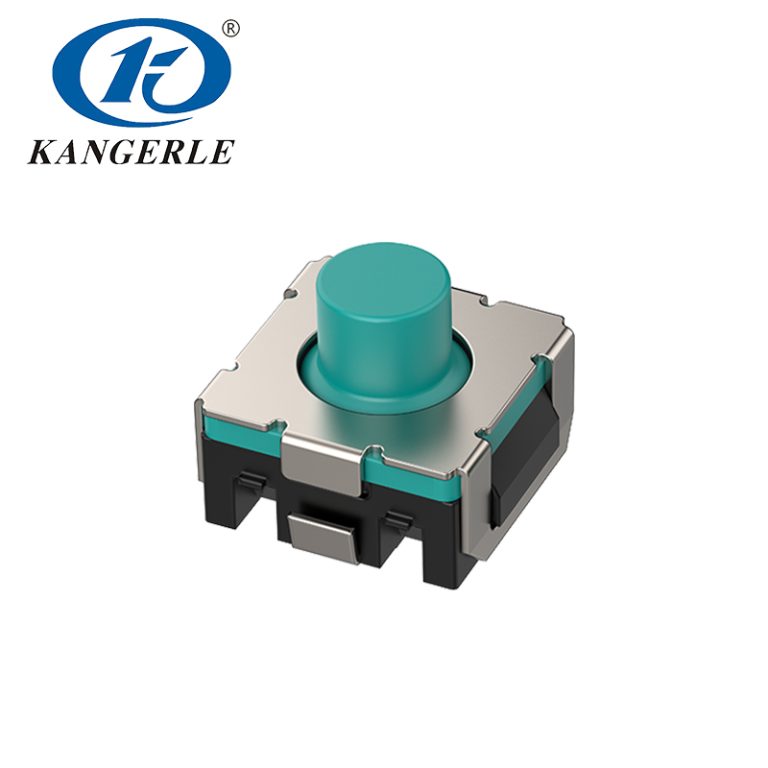
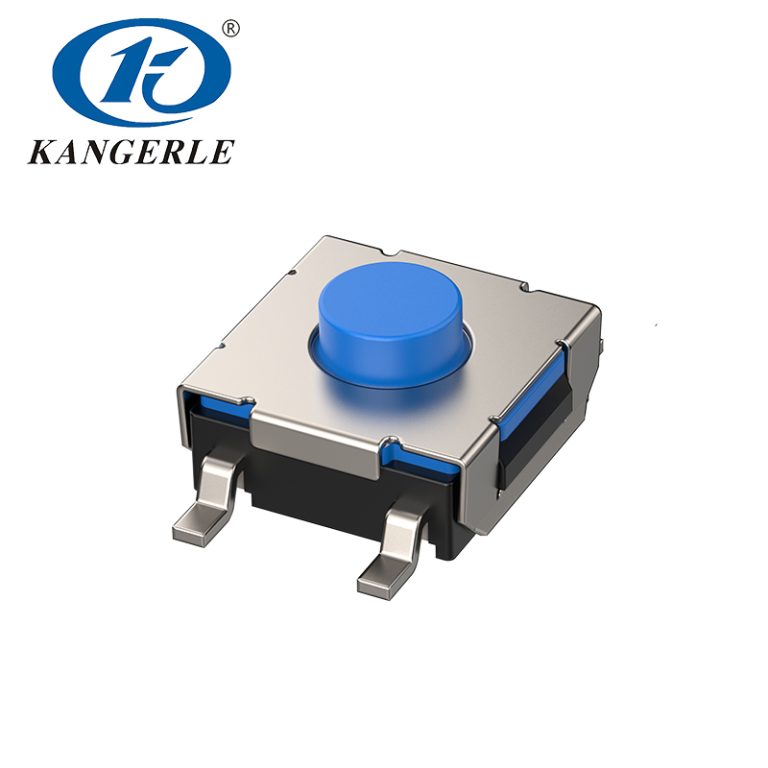
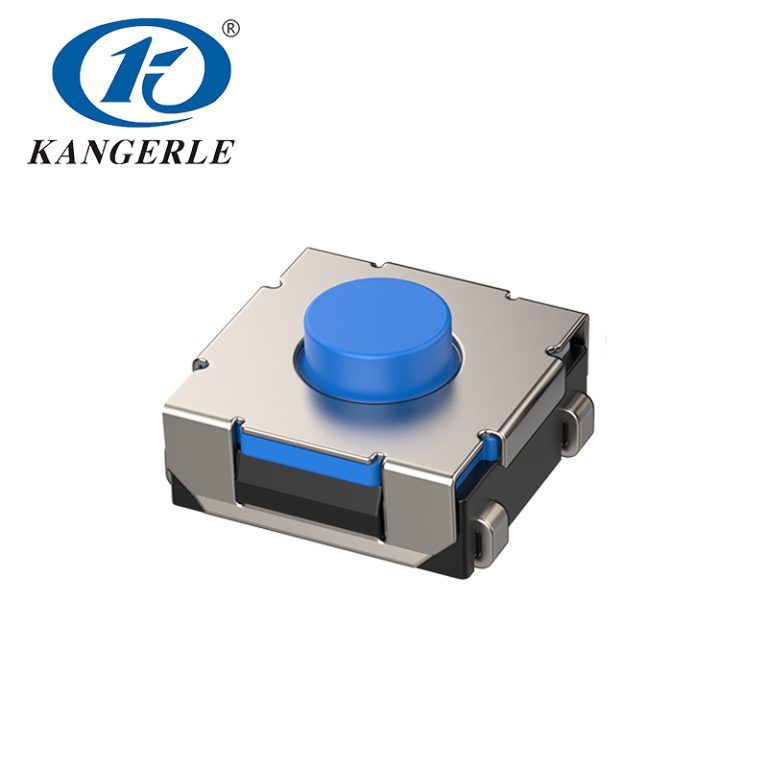
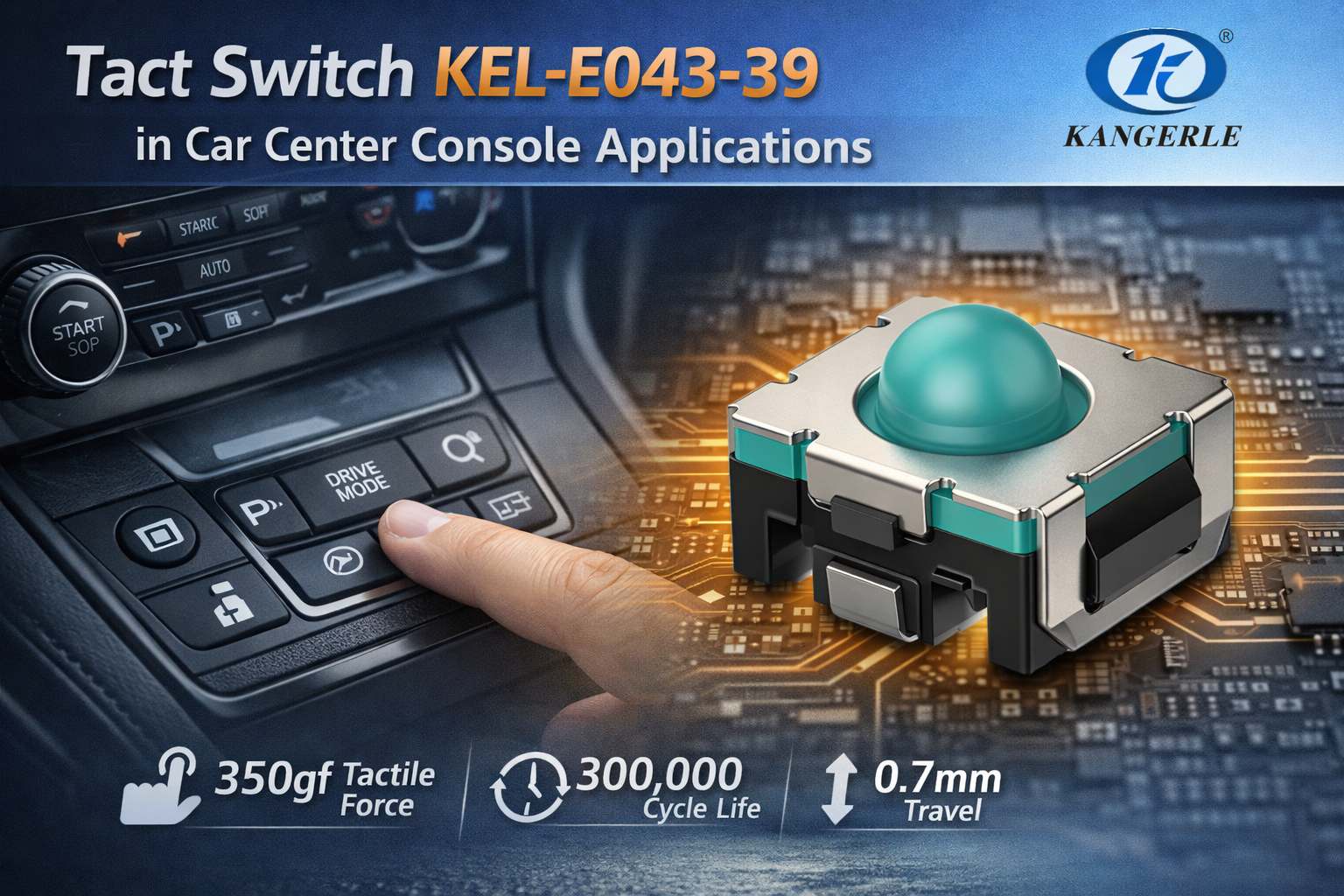
 A car center console switch does more than close a circuit. It shapes how a driver adjusts cabin temperature, changes drive modes, turns on seat heating, or jumps to a common infotainment function without hunting through layers of glass menus. In that setting, the right automotive tactile switch has to feel clear, react the same way every time, and keep working after years of repeated presses. Research comparing in-vehicle touchscreens with physical controls continues to show why tactile input still matters in driving tasks, especially when the control is used often and under time pressure.
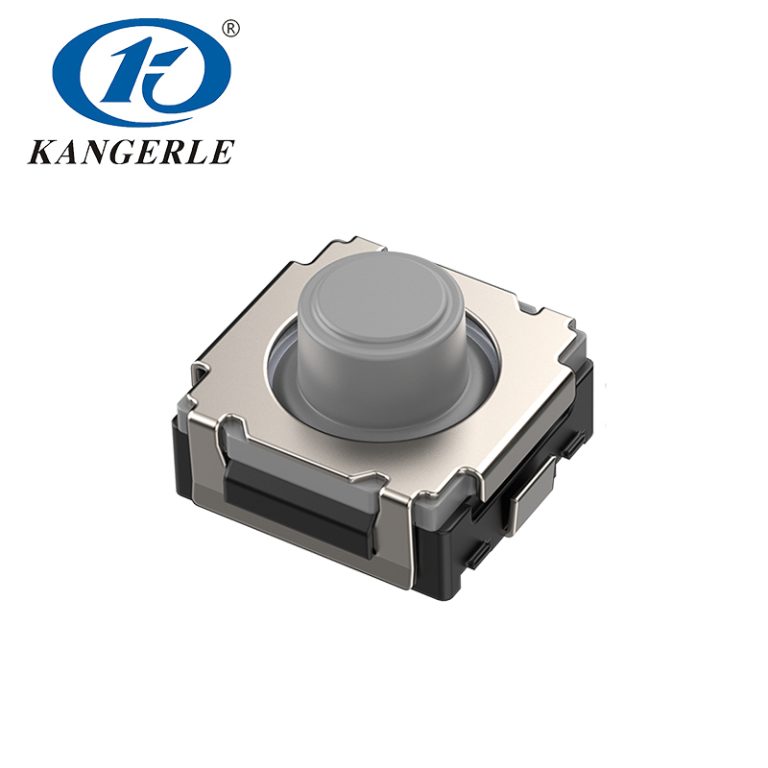
For this kind of human-machine interface, the Kangerle Switch E043-39 stands out as a practical fit for car center console switch design. Built for automotive dashboards and central control panels, the KEL-E043-39 combines 300,000-cycle mechanical life, 350±50gf operating force, 0.7±0.15 mm travel, and low contact resistance in a compact tactile switch format. Those numbers matter because they translate into a button that feels deliberate, not vague, and stays stable in daily use.
Why automotive tactile switches still matter in the center console
The center console has changed a lot. Screens are larger. Surface styling is cleaner. Yet the most-used functions still benefit from a physical press.
That is why automotive interior switch design keeps returning to tactile feedback in the places drivers touch the most. A well-tuned tact switch for car dashboard and console use helps the hand find the command quickly, confirms actuation through force and travel, and reduces uncertainty when the road is rough or attention is split. Industry materials for automotive interiors consistently put tactile switches in middle console, dashboard, lighting, and control-panel roles for exactly these reasons.
Flat surfaces look clean, but they are not always the best answer
A smooth panel works for style. It is less convincing when the driver wants a fast, repeatable command. Climate shortcuts, parking camera keys, drive mode buttons, start-stop overrides, and seat comfort controls are all easier to use when a distinct press confirms the input.
That does not mean every vehicle needs a dense field of hard keys. It means the functions used by feel should still feel like something. A center console button switch with a crisp tactile point remains one of the simplest ways to achieve that balance.
What a good center console switch needs to deliver
For a tactile push button switch in automotive HMI, three things usually decide whether the part fits the job:
- a force level high enough to avoid accidental input
- travel that is short but easy to perceive
- life performance that holds up under repeated daily use
That is the space where the KEL-E043-39 is strong. Its 350gf operating force and 0.7 mm travel give a press that feels clear without becoming heavy. Its 300,000-cycle rating also puts it in the range expected for frequently used vehicle controls.
Where KEL-E043-39 works best in a car center console
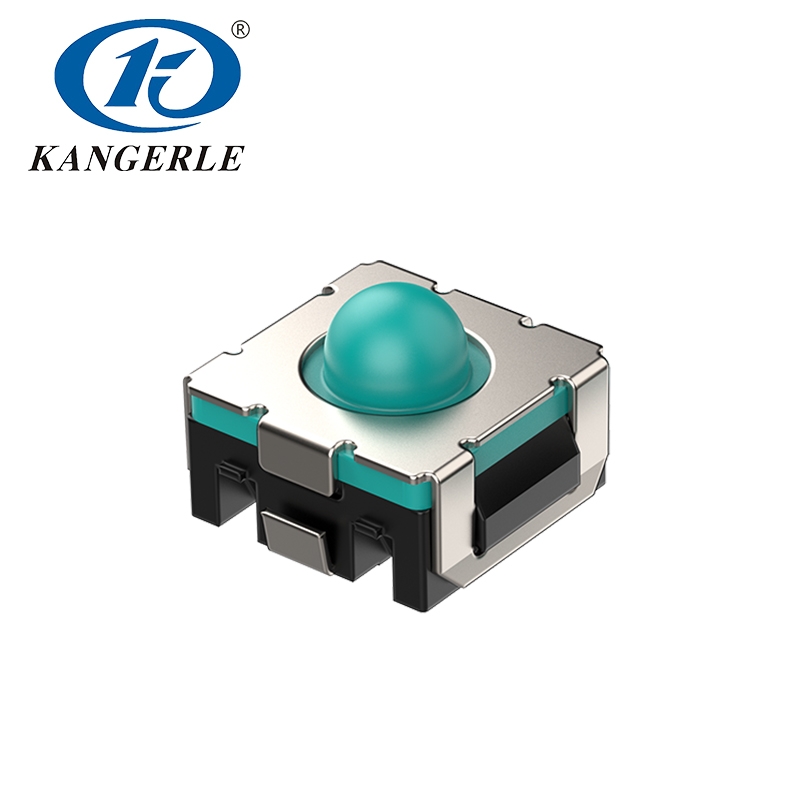 A center console is not one single button zone. It includes several sub-areas, and each one places slightly different demands on the switch underneath.
The KEL-E043-39 is most convincing where a compact automotive tactile switch must support short-stroke, repeated, confident input. Typical examples include climate-control keys, seat comfort buttons, infotainment shortcuts, parking-assist keys, and mode-selection buttons near the main control stack. Its product positioning also extends naturally to central control panels and other automotive button locations.
High-use comfort and climate controls
HVAC and comfort controls are pressed again and again. Fan speed, front defrost, recirculation, seat heating, seat ventilation, and temperature up/down keys all need consistent feel. A switch that softens too early or varies too much in force makes the whole panel feel cheap.
Here, the E043-39 suits the job because its force window is firm enough to be intentional, while the short travel keeps panel movement tight. That combination helps create the “clean but mechanical” feel many center console designs aim for.
Infotainment shortcuts and drive-mode keys
The second strong use case is for shortcuts the driver wants without looking twice: home, media, camera, parking assist, auto-hold, or drive-mode selection. These are not decorative buttons. They are commands with a direct effect on vehicle interaction.
A sealed or stable-feeling SMT tact switch is often preferred here because it supports compact PCB layouts and predictable tactile response. The E043-39’s low contact resistance and high insulation resistance help support clean signal switching in these low-current control circuits.
Typical center-console fit points
| Center console function | What the switch has to do | Why KEL-E043-39 fits |
|---|---|---|
| HVAC hard keys | Handle frequent repeated presses | 300,000-cycle life and crisp 350gf feel |
| Seat heating or ventilation | Give clear confirmation through trim panels | 0.7 mm travel provides distinct tactile point |
| Camera or parking assist | Avoid vague input during quick operation | Low contact resistance supports stable switching |
| Drive mode buttons | Feel deliberate, not accidental | Medium-high operating force helps prevent false touches |
| Infotainment shortcut keys | Work in compact PCB layouts | SMT tactile structure suits dense center stack designs |
Why the E043-39 matches real center console requirements
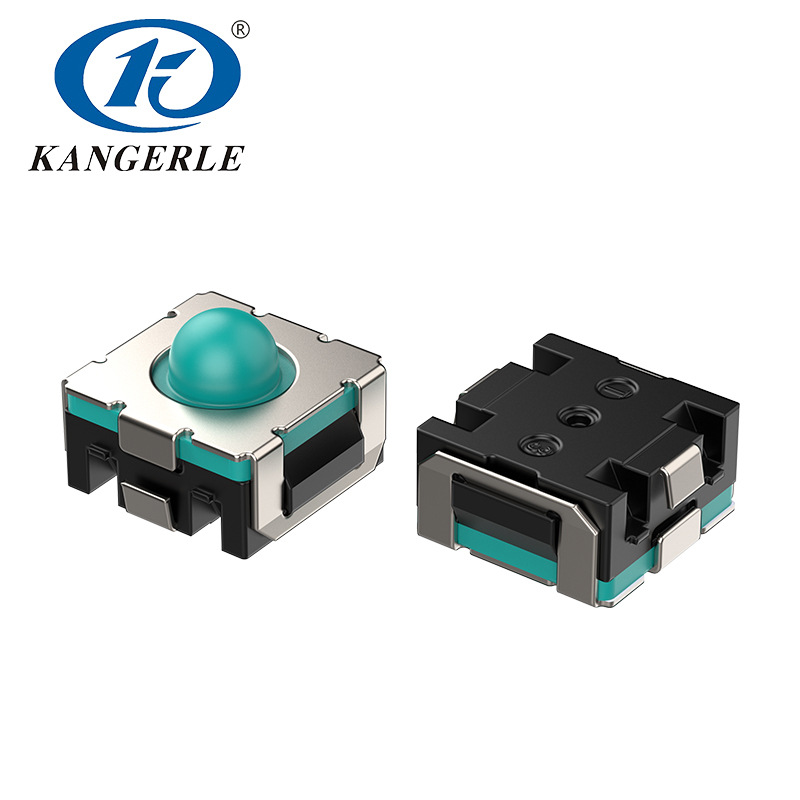
Numbers alone do not sell a switch, but they do explain why one part feels right in a finished panel and another does not.
The KEL-E043-39 is rated at 50mA DC 12V, with contact resistance of 50mΩ max, insulation resistance of 100MΩ min, and 250V withstand voltage for one minute. For low-current automotive control logic, that is a solid and familiar specification set. More important, the balance between force, travel, and cycle life lands in a range that center console designers use again and again for tactile HMI.
Force and travel that feel right in the hand
Automotive switch ergonomics research has repeatedly pointed to a working band around the mid-force range for push-return controls. That is not surprising. Too light, and the button feels accidental. Too heavy, and repeated use becomes tiring. The E043-39 sits close to that preferred zone with its 350±50gf operating force. Its 0.7 mm travel also gives enough movement to be noticed without making the button feel loose.
Durability for everyday vehicle use
Center console buttons may not seem extreme, but they live a hard life. They face dust, hand oils, vibration, heat cycles, and thousands of user interactions. The E043-39’s 300,000 mechanical cycles are a useful margin for controls used throughout the vehicle life cycle, especially in mid-use and high-use positions on the central control panel.
Tact Switch KEL-E043-39 vs ALPS SKSU series
For many buyers, the key question is simple: can this switch replace an established automotive tact switch without changing the user experience?
In functional terms, the answer is yes for center-console programs built around the common 3.5N, 0.7 mm travel specification window represented by the ALPS SKSU series. Official product data shows a close match in operating force, travel, voltage proof, and insulation resistance, while the KEL-E043-39 also offers a higher listed mechanical life and lower listed contact resistance.
Parameter comparison
| Item | KEL-E043-39 | ALPS SKSU representative spec |
|---|---|---|
| Operating force | 350±50gf | 3.5N |
| Travel | 0.7±0.15 mm | 0.7 mm |
| Rated load | 50mA DC 12V | 50mA 16V DC |
| Mechanical life | 300,000 cycles | 250,000 cycles |
| Contact resistance | ≤50mΩ | 100mΩ max. |
| Insulation resistance | ≥100MΩ | 100MΩ min. |
| Withstand voltage | 250V, 50Hz, 1 min | 250V AC, 1 min |
Why KEL-E043-39 can fully replace SKSU-series function
From a function standpoint, KEL-E043-39 can fully replace the role of the ALPS SKSU series in many car center console switch designs. The tactile force level is effectively the same. Travel is the same class. Electrical load, insulation, and voltage proof are in the same application range. Mechanical life is at least comparable and, by listed spec, higher on the Kangerle side. For buyers trying to keep the same press feel and circuit behavior while lowering sourcing pressure, that makes the KEL-E043-39 a serious substitute rather than a compromise part. The final PCB footprint and housing fit still need normal project verification, but the functional replacement case is strong.
Why sourcing teams look at ZHEJIANG KANGERLE ELECTRONICS CO. LTD
A switch is only as useful as the supplier behind it. That matters even more in automotive electronics, where delivery stability and engineering response can delay or move a whole program.
ZHEJIANG KANGERLE ELECTRONICS CO. LTD has been making switches for more than 20 years, with over 20 engineers, monthly production above 50 million pieces, and management systems including ISO9001:2015 and IATF 16949. Its product range covers tact switches, waterproof tact switches, illuminated tact switches, micro switches, rocker switches, slide switches, and related switch categories, with automotive listed among its solution areas. The company also supports OEM and ODM development, including changes to materials, dimensions, operating force, travel, current requirement, and special-environment use.
Practical supply advantages for replacement projects
For purchasing teams and design houses, that matters because a replacement switch project usually has two goals at once: keep function stable and improve supply conditions. KANGERLE ELECTRONICS’ Tact Switch KEL-E043-39 can fully replace the function of a mainstream branded switch in center-console use, while also offering shorter lead time, lower cost, and customization support. Sample requests and quotation access are already set up through its contact channel, which helps speed up evaluation and sourcing decisions.
Conclusion
The center console is one of the few places in a car where the user can feel component quality every day. A switch that is too soft, too vague, or too inconsistent will be noticed quickly. One that feels crisp and reliable disappears into the experience, which is exactly what a good center console button should do.
For that job, the Kangerle Switch E043-39 is a strong automotive tactile switch choice. Its 350gf operating force, 0.7 mm travel, 300,000-cycle life, and stable electrical performance make it well suited to climate keys, infotainment shortcuts, drive-mode buttons, and other central control panel inputs. For teams comparing it with the ALPS SKSU series, the functional overlap is clear enough that KEL-E043-39 can serve as a full replacement option in many projects, while adding the practical advantages of faster supply response, lower cost, and custom support.
FAQs
Is KEL-E043-39 suitable for a car center console switch?
Yes. The KEL-E043-39 is positioned for automotive dashboards and central control panels, with 300,000-cycle life, 350±50gf operating force, and 0.7 mm travel, which fit common center console button needs well.
Can KEL-E043-39 replace the ALPS SKSU series?
For many center-console applications, yes. The key operating values are very close: around 3.5N operating force, 0.7 mm travel, similar low-current automotive ratings, and matching insulation and voltage-proof classes. That makes KEL-E043-39 a practical functional replacement for SKSU-series use cases.
What kind of automotive buttons can use KEL-E043-39?
Typical uses include HVAC keys, seat comfort buttons, parking assist buttons, infotainment shortcuts, and drive-mode controls on the central control panel. It also has broader vehicle applications such as steering wheel buttons, dome lights, power window switches, and trunk release buttons.
Why is tactile feedback still important in automotive interior switch design?
Because a tactile switch gives physical confirmation. The driver can feel the press point instead of relying only on visual confirmation from a screen. That is especially useful for common center-console functions that need quick, repeatable input while driving.
Does ZHEJIANG KANGERLE ELECTRONICS CO. LTD support customization for automotive tactile switches?
Yes. Its OEM and ODM capability covers changes to materials, dimensions, operating force, travel, current requirement, and special-use environments, which is valuable when adapting an automotive tactile switch for a new center console layout or replacement project.