

A slide switch is used to open, close, or redirect an electrical circuit by moving a small lever from one position to another. It looks simple, but it often decides how a product turns on, changes mode, selects a signal, or locks a function. In daily products, slide switches appear in electric fans, hair dryers, power tools, radios, cameras, toys, security devices, communication equipment, and many PCB-mounted control designs.
For product engineers and buyers, the key point is not only what a slide switch does. The better question is where it fits, what circuit type is needed, and which structure can survive real use in a finished product.
What Is a Slide Switch?
A slide switch is a mechanical electrical switch with a sliding actuator. When the user pushes the actuator left, right, or sometimes to a middle position, the internal contact changes its connection state. This movement can turn a circuit on, turn it off, or connect one circuit path to another.
How Does a Slide Switch Work?
Inside a slide switch there is one movable metal contact on the actuator. This contact touches different terminals as the actuator is moved. So in an simple ON/OFF switch circuit the switch opens or closes the circuit. In a mode selection switch circuit of course the same motion of the switch contact is used to connect one input to a number of different output terminals.
The slide switch is useful where a product needs to be in a fixed position, as opposed to a momentary switch that returns to its open position after being pressed. The user can see where the switch has been left and therefore will know if the device is off or on, locked or unlocked, muted or not, etc. He will also know what mode it has been set to.
Why Do Designers Still Use Slide Switches?
Many products use slide switches because they are small, easily read and for low voltage electronic control very practical. A slide switch does not need a screen, a software menu nor an indicator light to indicate its switched state. The position of the slider is clear for all users and indicates the selected position.
Common reasons include:
- Clear ON/OFF or mode position
- Small body size for tight product housing
- Easy manual operation
- Stable maintained switching
- Suitable structure for PCB mounting
- Simple circuit design for low-power products
For small articles such as consumer electronics, toys, home appliances and control modules this simplicity is advantageous as it keeps assembly simple and use easy.
What Is a Slide Switch Used For?
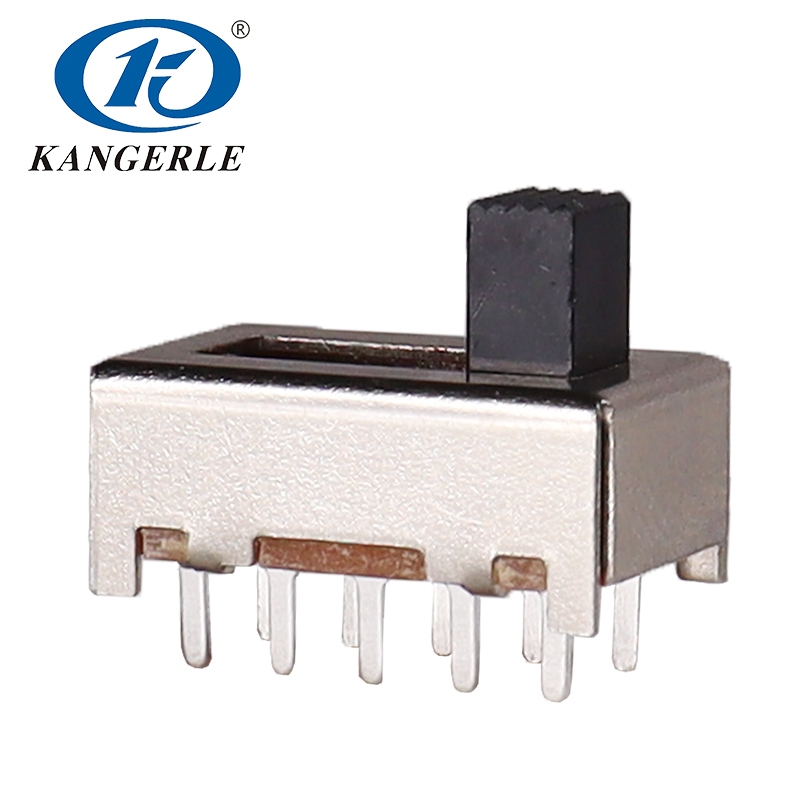
Slide switches can be organized into various switch uses by function. Generally speaking, the simple switch on the surface of a product is actually part of a larger system of how power flows, how circuits are selected, how a product is operated, and how a product is protected.
Power On and Off Control
The slide switch is most commonly used for simple power control. A small battery powered toy, a handheld lamp, a mini fan or a portable radio can utilize an ON/OFF slide switch to turn the battery powered circuit on and off.
This application usually uses a simple SPST slide switch. SPST means Single Pole Single Throw. It controls one circuit path with two states, ON and OFF. For low-current products, this structure is often enough.
Switches connect the battery pack to the sound or light module in toys. Small fans have a switch to start/stop the motor control circuit. A switch in a flashlight or portable gadget is used to cut the current to the batteries when the product is turned off and stored.
Mode Selection and Function Switching
Slide switches can also be used for selecting a number of different modes. Because a number of functions are to be incorporated into a housing which is not large enough to accommodate a number of different pushbuttons, a two-position or three-position slide switch can be used for this purpose.
Examples include:
- Low and high speed in small fans
- Cool and warm airflow in personal care devices
- Radio band selection
- Camera function selection
- Speaker or headphone output selection
- Manual and automatic control in small modules
An SPDT slide switch is commonly used for this type of operation. It is able to connect one input to two outputs, allowing the user to select between 2 different paths within a circuit using only 1 switch slider.
Signal Routing on a Circuit Board
In manufacturing of electronics switch of type slide switch are often mounted directly on PCB. They are not used very often by end user, instead they are used by engineers or by installers to set up a product in required configuration.
PCB slide switches can be used to select addresses, a test mode, voltage, standby or to route signals. In a security system such as an intrusion detector a slide switch can be used to set a sensor in a particular mode. In a communication system such as a modem a slide switch can be used to select a channel or an internal configuration. A slide switch can also be used in a test fixture to switch between two measurement paths.
DIP slide switches are quite common in such work, since they offer a number of small switching positions in a row, which makes them ideal for board-level settings that are of small size.
Safety Locking and Manual Control
There are many products that incorporate a slide switch into their design as a manual lock. For a handheld product a slide lock is ideal as it prevents accidental use of the product. A small tool may also have a slide switch to separate the product from standby to active. For a product for children it can prevent accidental discharge of the battery when the item is in a bag or in storage.
Such use is dependent on the maintained position of the switch. Because the slider does not return to its original position, users can confirm the switch position just before use of the product.
Which Devices Commonly Use Slide Switches?
There are numerous fields where slide switches can be used. All fields have their own specific applications, which are limited by load, space, accessibility and environment.
Consumer Electronics
In consumer electronics articles a number of requirements have to be met. Parts have to be as compact as possible, the construction simple and the housing clean. A slide switch for example is very suitable for articles like radios, cameras, remote controls, handheld games, portable speakers and other small audio equipment. It can be mounted along one of the sides of the housing.
For products where the switch may perform functions such as power, mute, input source, and mode, even though the current is low, user feel is very important. A loose slider feels inexpensive to the user. A slider that is too stiff also feels poorly to the user. Therefore, check the operating force during sample testing and do not delay until after mass production.
Home Appliances and Personal Care Devices
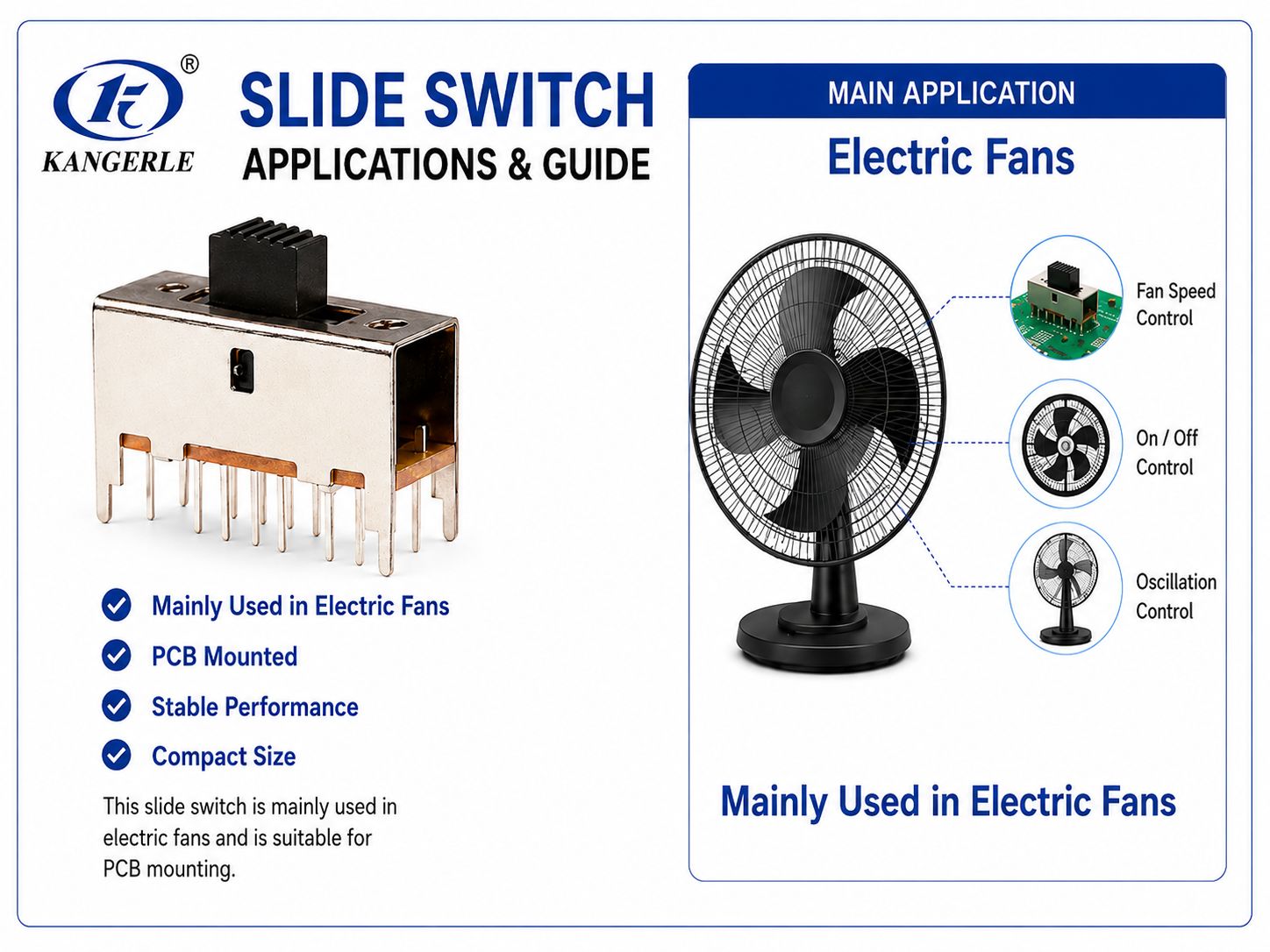
Slide switches are also used in many home appliances and personal care appliances. Here are some examples of electric fans, hair dryers, other small kitchen appliances, hair clippers, and other personal care trimmers and cleaning appliances that may need to be switched for speed or for other functions.
For example, a hair dryer would need OFF positions for Off, Low Airflow and High Airflow. A small fan would use a simple slide switch to change between low, medium and high speed. A power tool accessory or small household appliance would use the switch to turn On/Off or to select a function.
In all these applications the shape of the housing and the position where the user applies force are critical. This determines the height, stroke and space available on the panel for the actuator and the housing of the actuator.
Toys and Battery-Powered Products
One of the applications for slide switches is battery-powered toys. As an example, a slide switch could be used to switch ON/OFF items such as lights, sounds, motors, and sensors. Given that toys made to operate with batteries can get dropped, and therefore get shaken about, and are used by children who cannot be expected to treat them carefully, the slide switch should not be too easy to operate.
Mini slide switches are selected for toys because the product body is usually too small. A good component for use in this field should have a stable contact, a suitable switching force and be easy to assemble on the PCB or into the plastic housing.
Automotive and Vehicle Parts
Slide switches can be used in automotive interior controls and other vehicle modules. Their application is restricted to the respective switch ratings. Possible fields of application are reading lights, small control panels, seat functions, mirror and accessory functions.
Using an automotive environment as opposed to sitting on a desk has more considerations. Look at the temperature range, the amount of vibration and its effect on the switch as well as the contact stability in both open and closed position over the switch’s life cycle. In addition to the above, also consider the environmental sealing requirements for use in various markets and verify that the above aspects can be meet with a low current signal switch. Its design and operation will need to match out the overall module’s validation plan.
Industrial, Security, and Communication Equipment
Some industrial equipment, access control devices, alarms, sensors, communication modules, and test equipment are provided with slide switches to set, reset, select operation mode or to configure the equipment for service.
In the applications described in this article switches are often used by service technicians rather than end users. Hence label with clearly marked positions, rugged reliable contacts, simple through hole mounting, are more important to technicians than a switch’s cosmetic looks. In applications which will be used in dusty or humid locations it is important to investigate the switch’s contacts, switch body, environmental resistance, test data, etc. before making a purchase.
What Are the Main Types of Slide Switches?
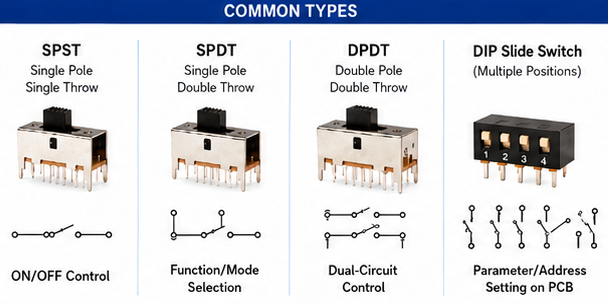
There are many different types of slide switches and each would be suited for different applications. Even though a switch may look the same on the outside, the application can call for completely different internal wiring configurations.
How Do SPST, SPDT, and DPDT Slide Switches Differ?
Main characteristics of common slide switch configurations are listed in the table below.
| Type | Full Name | Main Function | Common Use |
| SPST | Single Pole Single Throw | Turns one circuit on or off | Battery toys, lights, small gadgets |
| SPDT | Single Pole Double Throw | Selects between two circuit paths | Mode selection, signal routing, source selection |
| DPDT | Double Pole Double Throw | Controls two circuits at the same time | Polarity change, motor direction, paired circuit switching |
| DIP Slide Switch | Dual in-line package switch | Provides multiple small switches on a PCB | Board configuration, address setting, service mode |
| Mini Slide Switch | Compact slide switch | Saves space in small products | Cameras, toys, small appliances, portable devices |
A simple SPST slide switch is generally the best choice for simple On/Off switching. An SPDT switch is typically best used for a single input that needs to be switched to two different outputs. Two related circuits are switched together with a DPDT switch.
When Should a Mini Slide Switch Be Used?
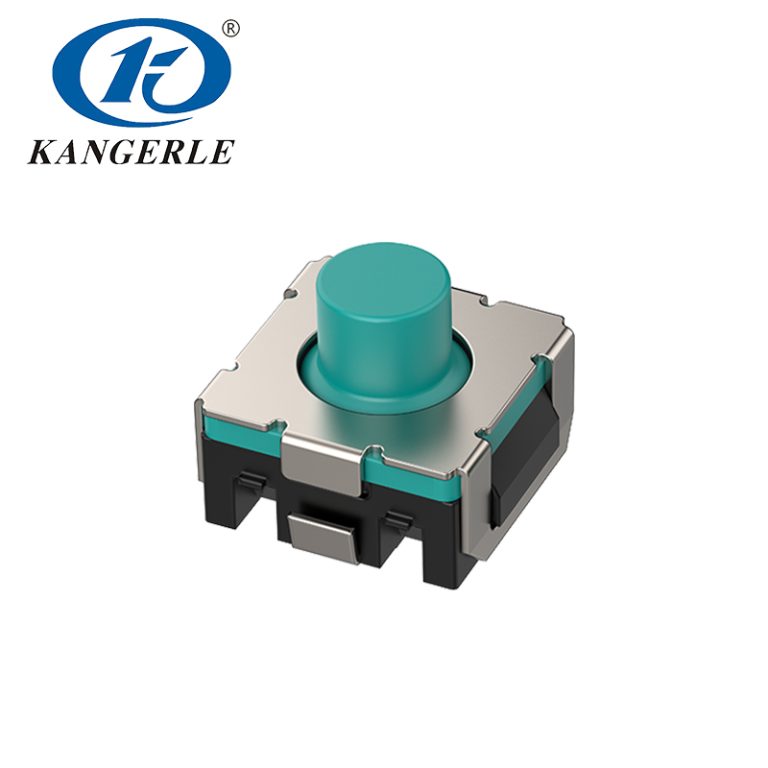
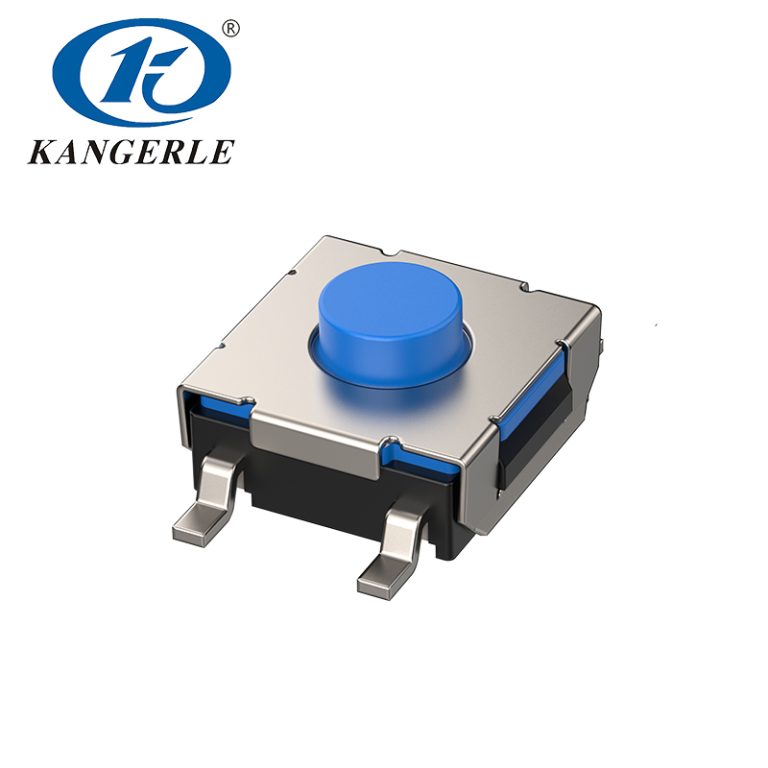
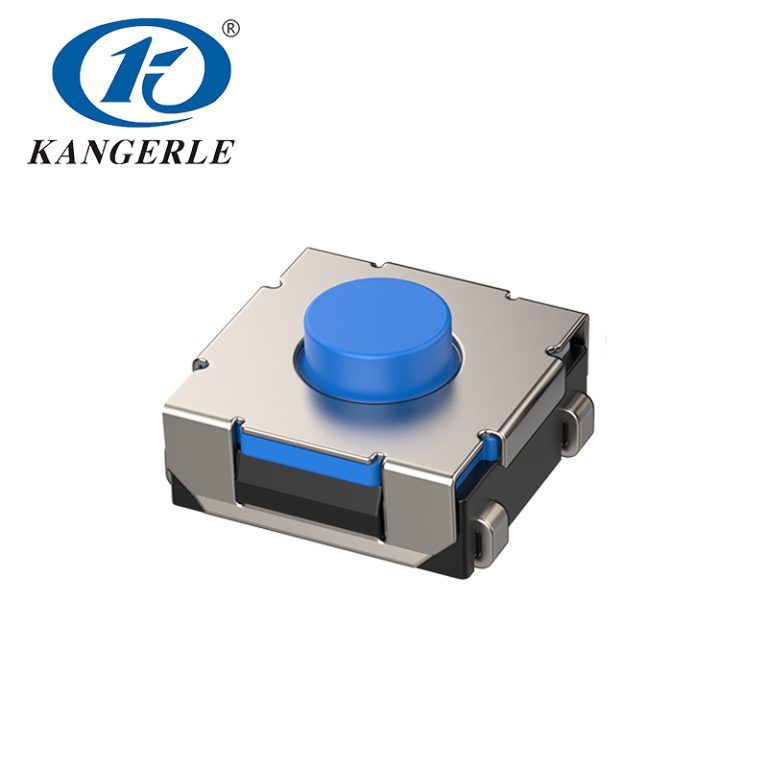
Small compact slide switches are very useful in applications where space is a problem and you still need a manual switch. This type of switch is widely used on portable electronic products, appliances, children’s toys, cameras, and many other products that are small and need to be manually switched.
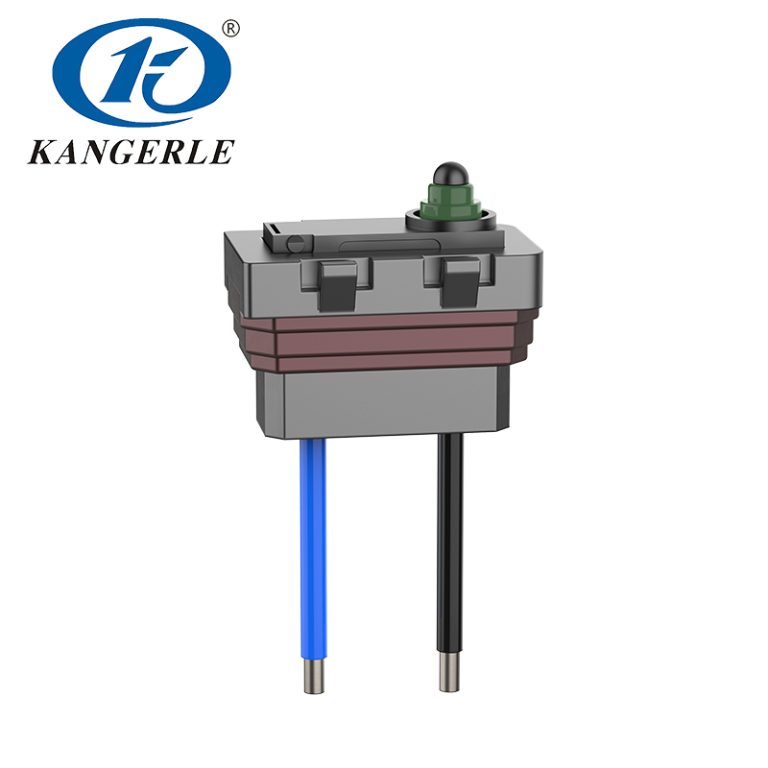
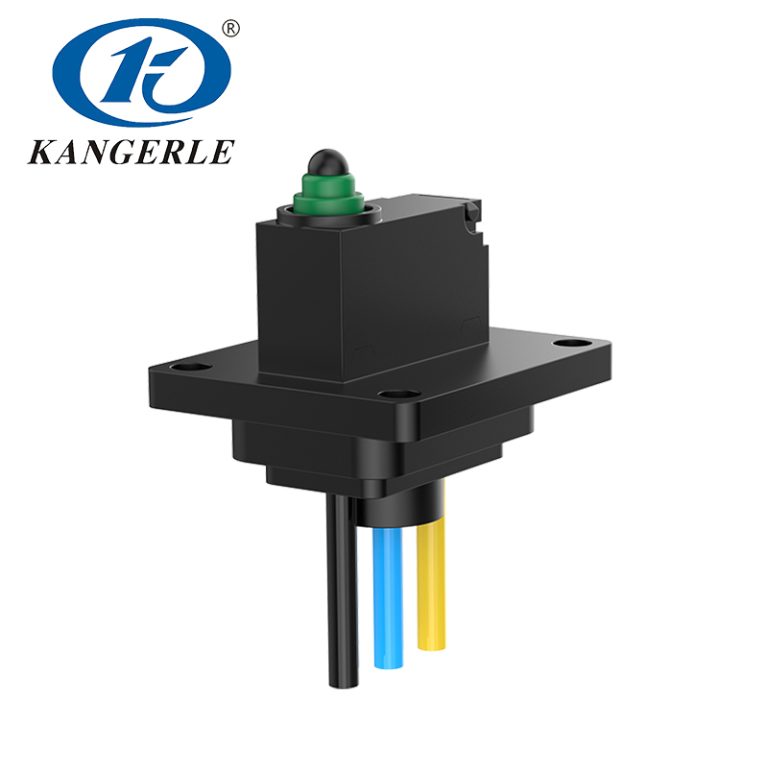
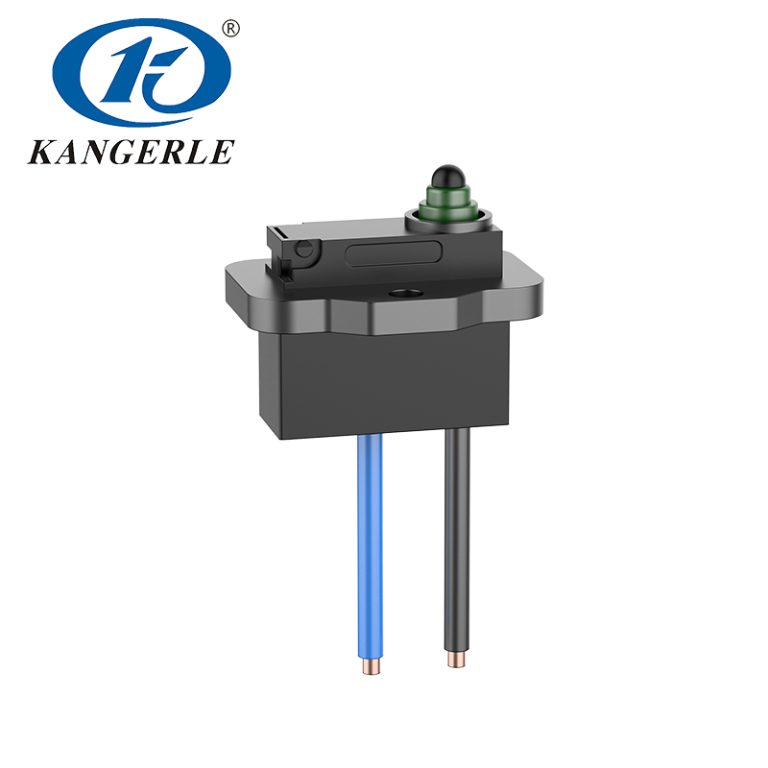
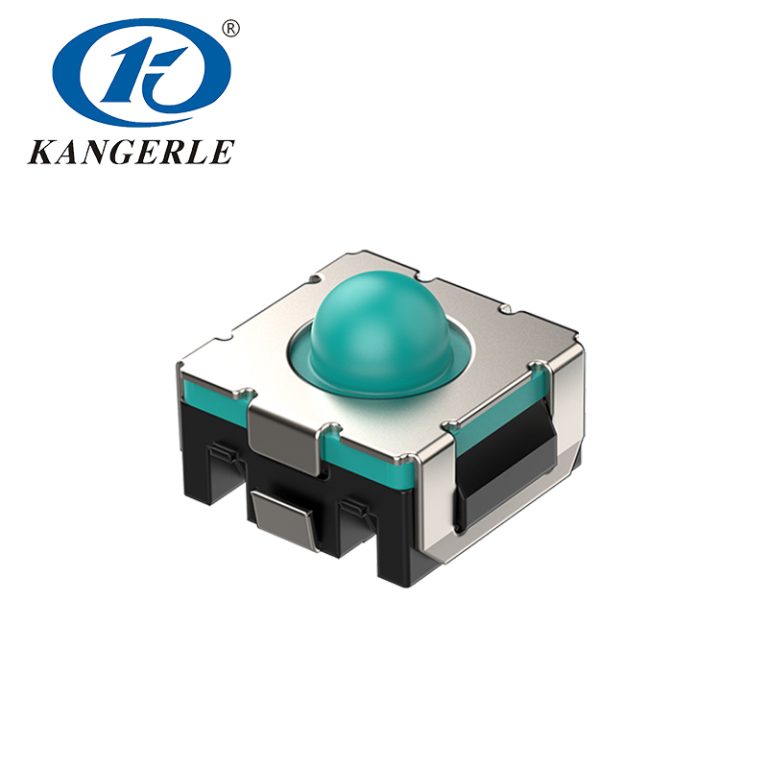
The KANGERLE mini slide switch has several circuit forms such as SPDT, SPST NO, SPST NC. Low current for the electronic control. For example, a series of the KANGERLE mini slide switch has a 50mA 12V DC rated load. Operating temperature is from -25°C to 85°C. The contact resistance is 50mΩ or below. The insulation resistance is 100MΩ or above. The electrical life is 10,000 cycles or more. This information is important for a buyer to refer before selecting a switch model.
When Should a DIP Slide Switch Be Used?
DIP slide switches are mounted on a circuit board and are not typically a switch that a consumer would be moving on a daily basis. These type of switches are used by the manufacturers, installers and service personnel to set up the internal configuration of a product.
Typical uses include:
- Device address setting
- PCB function selection
- Test mode control
- Communication parameter setting
- Hardware configuration before shipment
DIP slide switches can be used to deter software changes, but more typically they are used to set a physical parameter that should not be changed after installation.
How Do You Choose the Right Slide Switch?
When selecting a slide switch, it is important to start with the application’s circuit and not just how the switch looks. A switch that appears to be a good fit for an application can still fail because of factors such as rating, terminal configuration, actuator size, or required actuation force that are not met by the part.
Which Specifications Matter Most?
This table can be used by the buyer and engineer during the early selection process to compare features of various slide switches.
| Selection Point | What to Check | Why It Matters |
| Circuit type | SPST, SPDT, DPDT, ON/OFF/ON | Matches the real switching job |
| Rated load | Voltage and current | Prevents overheating and early contact failure |
| Mounting style | PCB, through-hole, surface mount, panel mount | Affects assembly and PCB layout |
| Terminal type | Solder pin, DIP, SMD, wire connection | Matches production process |
| Actuator size | Height, width, travel | Fits the housing and user touch area |
| Operating force | Light, medium, or firm sliding feel | Affects user experience and false movement risk |
| Life cycle | Mechanical and electrical life | Supports long-term product reliability |
| Environment | Temperature, dust, moisture, vibration | Matches actual working conditions |
For many low-current electronic products, the wrong actuator height causes more trouble than the wrong color or shell shape. The switch must align with the plastic housing, PCB height, and user finger position. In high-volume products, even a 0.2 mm mismatch can lead to poor touch feel or difficult assembly.
How Should Buyers Match Ratings to Real Use?
Verify the voltage and current of the circuit for which the switch is intended. A slide switch designed for low current signal switching has different design stresses than a switch intended for use near a motor or heating element. Sample test for switch life under conditions of inrush current, vibration, and repeated on/off cycling while under load.
In signal circuits the contact resistance plays a significant role. High or even instable contact resistance leads to poor signal, noise, or faulty control. The insulation resistance and the withstand voltage give information on whether or not a switch will safely isolate two circuits in a specified situation.
What Should Be Checked Before Mass Production?
Before confirming a slide switch for production, the project team should check.
- PCB footprint and soldering method
- Switch height after assembly
- Actuator travel and panel opening
- Operating force after the product shell is installed
- Electrical load under real working conditions
- Life test plan
- Temperature and humidity needs
- Packaging and feeding method for assembly
This review would be especially useful for us as OEM products. As always, it is easy to test a switch in isolation on a workbench but the finished product is housed in something that exerts pressure on the switch and is used under varying amounts of force by the user. Also the switch is connected to wires which must be routed in some way and it is subject to all the normal variations in dimensions found in mass production.
Why Work With ZHEJIANG KANGERLE ELECTRONICS CO. LTD?
ZHEJIANG KANGERLE ELECTRONICS CO. LTD is a switch supplier for household appliances, security, video, communication, automotive, computers and other fields. Founded in early 1990s in Wenzhou, the company supplies Micro Switches, Detector Switches, Limit Switches, Rocker Switches, Slide Switches, Tact Switches, Push Button Switches, Connectors, Car Switches and switches for household appliances.
Our company has in-house engineering/technical support for development and production. We have a full Quality System certified to ISO9001:2015 and IATF16949. Our switches are certified to UL, TUV, CE, CB, CQC and hold RoHS compliance. We can supply in excess of 50 million switches per month. This is a huge advantage to potential buyers, as first samples can be sent very quickly, and then production can continue at same high level once official production release has taken place.
For custom slide switch production we can provide support for choice of materials, sizes, operating force, operating travel, required current and special working environment. We provide ODM/OEM services including design of molds, production of molds, testing of samples and mass production. Our customers come from appliance, automotive, security, industrial and consumer electronics fields. We help to transform our customers ideas into production of high quality switches.
Conclusion
A slide switch can be used as a power control, mode switching, circuit path switching, manual locking or PCB configuration switch. A slide switch is common in many kind of applications like: electronics, home appliances, toys, automotive parts, industrial controls, security systems, communication devices etc. because of its clear maintained position in a very compact structure.
Matching a slide switch to the circuit type, rated load, mounting, terminal, size, operating force, life, and environment ensures that the switch is the right switch for your application. For OEM applications and high volume production, even sample testing in the actual housing is as important as checking the switch’s datasheet. A good slide switch can make your product easier to use, easier to assemble, and more reliable in service.
FAQs
What is a slide switch used for?
Slide switches are used to switch on/off, to select operating modes, to route signals, to lock a function or to set a PCB configuration. They are used in many kinds of small electronic applications like home appliances, toys, car applications, safety and security and communication applications.
What is the difference between an SPST and SPDT slide switch?
An SPST switch is used to control one circuit for On and Off. Simple power control is typical. An SPDT switch is used to connect one input to one of two outputs. This is typical for mode switching, signal switching or for switching a source.
Can a slide switch be used on a circuit board?
Yes. There are slide switches for PCB and DIP slide switches. Slide switches are used for power control, for board settings, for address selection, for test mode and for hardware configuration.
Is a mini slide switch suitable for toys and portable devices?
Yes. A small slide switch is often used in toys, in cameras, in small fans, in portable electronic devices. We will look for a switch that matches your current specification for rating, for operating force, for size and for expected life.
How do buyers choose a slide switch manufacturer?
It is important for buyers to check various factors including the product range that the supplier can offer. Also the level of engineering support offered by the supplier, ability of supplier to offer customization, various certifications held by supplier, sample process, production capacity and past experience of supplier in similar application. For OEM projects it is also important to know how supplier can support for mold design, sample testing and mass production.